
We are entering a new year and, naturally, questions abound about what it might mean for the Federal Government, and the Ontario Legislature. Although making bold predictions can be a difficult endeavor, in this case, the respective futures of these three bodies can be divined using varying combinations of these three words: stability, change, and uncertainty.
The Federal Government – Stability, Change, and Uncertainty
With the House of Commons returning officially on January 28
th, what can Canadians expect from the Harper Government in 2013? A lot of stability, a few changes, and a little uncertainty mixed in for good measure.
Looking into the Grassroots Public Affairs crystal ball, it is easy to spot stability in the federal government’s future: barring any unforeseen scandal, the majority Harper Government is here to stay until an election is called in 2015. For the most part, this will mean renewed focus on the domestic and international economy, including an emphasis on both deficit reduction and the creation and completion of new international trade pacts such as impending major free-trade deals with both China and the E.U. In addition, it has been suggested by some that the 2013 Federal Budget, now entering the final phase of pre-budget consultations, will not contain any earth shattering changes, but will forge ahead with the government’s economic strategy of the past two years.
Along with stability, Canadians can also expect a modicum of change within the federal government. Minister Flaherty has recently revised his economic forecasts, stating that it will now take Canada a year longer than predicted to balance the budget - due to a drop in income driven by lower than expected commodity prices within a volatile global market. The government now expects that revenues will be $7.2 billion below budget expectations over the next five years, and predicts that the deficit will reach $26 billion this year; an increase of $5 billion from the 2012 budget forecast. Minister Flaherty nonetheless continues to offer a hopeful outlook for the future, since despite these changes to the forecast, Canada remains among the strongest G7 economies.
There may also be a fairly significant cabinet shuffle coming in 2013, with pundits predicting that the Prime Minister will try to give his government a fresh face heading into the second half of its majority. Among those rumoured to be replaced is embattled Defence Minister Peter McKay, who has presided over the highly controversial military procurement process, including both the F-35’s, and more recently the naval procurements; both of which, incidentally, are also expected to be reset and rethought.
Another change is coming in the form of a redistribution of federal riding boundaries, one which will see each riding become more proportionally represented in terms of population. While the final boundaries have yet to be determined, it is expected that the new population-based riding distribution will favour the ruling Conservatives with more seats being allocated to rural and suburban areas.
In addition to these changes, the federal Liberal leadership race will be in full swing this spring, with the leadership convention coming in mid-April. Although most expect odds-on favourite Justin Trudeau to emerge victorious, no matter who wins the Liberal leadership race, there will be someone new at the helm of the party through 2013 until the next federal election in 2015. With a strong emphasis placed on renewing their party brand, expect the Liberals to put forward some bold new policy ideas over the coming months.
There is also some uncertainty coming in 2013 stemming from the federal government’s complicat
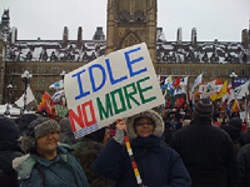
ed relationship with Canada’s First Nations, which has recently come to a head through the efforts of the Idle No More movement and Attawapiskat Chief Theresa Spence. In response to the efforts of the Native grassroots movement, the Prime Minister recently pledged the start of high-level dialogue between the PMO and the Assembly of First Nations on treaty relationships and comprehensive land claims; a move which is generally seen as a positive first step in what could be a long process. The resolution to this situation is anything but clear, and its implications – especially in terms of resource development, could be far reaching.
Internationally, there is also a great deal of unpredictability - the kind that goes hand-in-hand with an often turbulent global economy. Although the United States narrowly avoided going over the fiscal cliff, they merely succeeded in postponing disaster for another few months while they try to work out a more long-term deal between their rancorous governing parties. We live in an increasingly interconnected world; any instability in the world’s leading economy (and Canada’s largest trading partner) will be felt by the rest of the world to varying degrees. It will be up to the federal government to manage the effects of that uncertainty throughout 2013 and beyond.
The Provincial Government – Change and Uncertainty, leading to… Stability?
When Dalton McGuinty surprised Ontarians by simultaneously proroguing parliament and resigning as Premier in October 2012, he ensured that stability would not be present within the legislature for much of 2013– at least until after what many anticipate will be a spring election. In the absence of stability, change and uncertainty will be the hallmarks of this year.
For the Liberal party of Ontario, that change is relatively easy to quantify. With a leadership convention coming at the
end of January (25
th-27
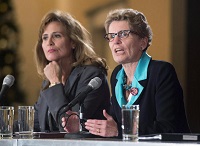
th), Ontario’s governing party will have its first new leader since Premier McGuinty won power in 2003. After a series of delegate elections this past weekend, the two front-runners for the position remain Kathleen Wynne and Sandra Pupatello. Pupatello emerged with 504 or 27.44% committed first ballot delegates, which was slightly ahead of Wynne who won 463 or 25.2%. Gerard Kennedy currently sits in third with 257 delegates, or 13.99%. With both Pupatello and Wynne firmly in the lead, it is likely that the province will emerge from the leadership convention with its first female Premier; however, no matter who the winner is, they are sure to face an uphill battle with
current polls showing the Liberals sitting in third place amongst the province’s three parties.
One possible factor in a possible spring election is a growing negativity towards the Liberals from the teacher’s union over what has become an extremely contentious contract dispute. Some teacher’s unions, who have traditionally and overwhelmingly supported the Liberals in the past, seem to have shifted their support towards the NDP. Each of the Liberal leadership candidates has pledged to repair the party’s fractured relationship with the teachers, although none has yet offered many specifics as to how they might achieve that goal. The relationship between the teacher’s unions and the new Liberal leader is worth monitoring as it could have major implications come election-time.
For the PC’s, change will not come in terms of party personnel, with Tim Hudak still firmly in control. How
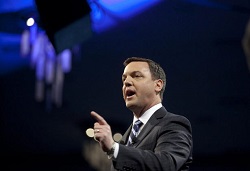
ever, though the leader remains the same, some pundits have noted a marked change in both his, and the party’s demeanor and approach over the past several weeks. In contrast to last year’s election, Hudak seems energized, confident, and comfortable in his own skin, drawing
positive reviews from several members of the press for his performance of late. In addition, the party has introduced a series of white papers that represent an attempt to kick-start a provincial conversation on a variety of topics. While these white papers are definitely controversial, they offer voters several clear and distinct policy alternatives to think about – something that many pundits felt was lacking last time around.
For the NDP, there is still some uncertainty in terms of election readiness. While the Liberals have garnered a lot of press due to their leadership contest, and the PC’s
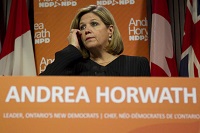
due to their white papers, the NDP to-date has remained relatively and conspicuously silent. Though it is inevitable that the NDP will change gears and get into election mode eventually, Leader Andrea Horwath has up until now taken a wait-and-see approach to her party’s policy announcements, perhaps until after the dust settles on the Liberal leadership convention.
Finally, the greatest degree of uncertainty provincially lies in what the end-result of the coming election will be. Perhaps more than at any point in the last 12 years, we are in a three horse race – one which any party, potentially, could win. Gazing once again into the Grassroots Public Affairs crystal ball, the outcome of the upcoming election is still hazy. Whatever the final result, most Ontarians would agree that it will hopefully add some stability – very few people want to be voting again at this time in 2014.