Whether to improve upon their election results, to combat voter apathy and cynicism, or simply strengthen party membership, various political parties across Canada have been advocating the need for fresh and more broadly appealing policy ideas. Within most parties, the process of policy and platform creation has, over time, trended towards turning to the entrenched party establishment for leadership, direction, and guidance. In many cases however, this strategy has resulted in policy, party, and membership stagnation; or the perpetual reaffirmation of the status quo. As a response to this, there has been a recent push within some of Canada’s major political parties to take a step back from the establishment and instead look outwards for fresh perspectives. The impetus to reach out to their grassroots bases and offer them a greater input into the policy process lies in the hopes that it will not only generate new ideas and reinvigorate the existing base, but also attract new members with the promise that their voices and opinions will immediately be heard. Although there is a lot of ongoing discussion within certain political parties surrounding grassroots engagement, only time will tell if their actions mirror their words.
The Creation of a Grassroots Base
The term ‘grassroots’ evokes images of a foundation that is organically grown from the bottom up, taking root naturally, as a product of the environment within which it is situated. In the case of grassroots politics, the environment is democracy itself. Democracy is widely accepted as a government that is elected by the people, for the people. A democratic government is thus by definition not a government that rules its people with an iron fist, but rather one whose power and mandate flows from the will of its citizens. Political parties are a natural by-product of the democratic system, and as such, are governed by the same fundamental principles.
The creation of a political party occurs when a group of like-minded people come together from across different locales to support and promote the ideologies and causes they believe in. This group of like-minded people forms the party’s membership, its foundation, or its  grassroots base. It is from this grassroots base and their common set of beliefs, that the political party initially draws its unique set of policies and principles; the values that define its very existence. The membership of the party elects its own leadership, and in effect, becomes a microcosm of the democratic system as a whole, complete with local riding associations in communities across the country. The leadership of the party derives its mandate from the grassroots base, which forms the party’s ideological core. In return, the leadership, with the input of various mechanisms such as membership driven policy advisory committees, are tasked with forming policy that is reflective of the will of the grassroots base. This is how democracy is supposed to work.
Over time, as political parties mature, their founding ideals can often become secondary to the ideals of their respective party establishments. The will of the central party begins to, in effect, hijack, and in many cases trump the will of the grassroots base. The danger here is the marginalization of the individual member, and of the individual local riding. Although the central leadership of a party is fully capable of creating a general policy that espouses the main principles of its membership, many of the local ideas that come out of policy advisory committees are often overlooked in favour of more centralized policies. In an increasingly apathetic political world, the marginalization of the individual grassroots party member does nothing to combat stagnation, or to encourage would-be participants in the political process.
The Liberal Party of Canada and Grassroots Outreach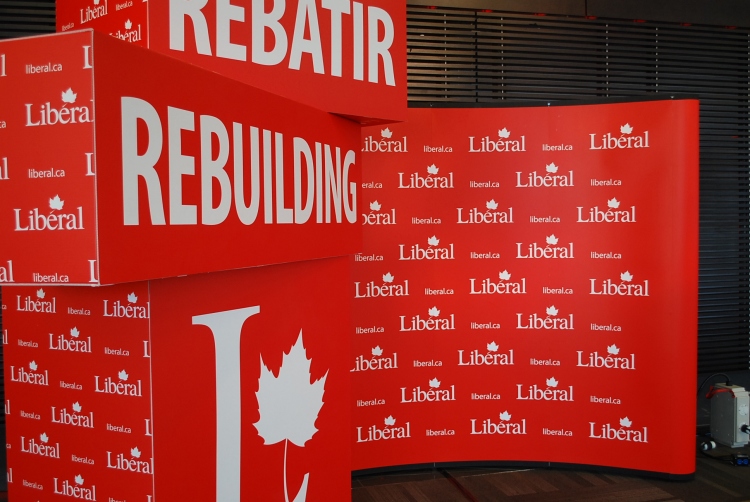
In the aftermath of the 2011 election, the federal Liberal party finds itself in uncharted territory as for the first time in its existence, the party finished a federal election in third place. The bleakness of this unforeseen situation has left the grassroots of the Liberal party demanding change. The danger with being a political powerhouse for so long is complacency. What the Liberal defeat suggests is that the party establishment for too long has been content with standing pat and riding the Liberal “brand” and historical electoral hegemony to victory. While this strategy has worked in the past, it has become apparent to many within the membership that the party needs to reinvigorate itself by taking a step back from the status-quo and moving instead towards a more open and democratic system, in search of new and creative policy ideas. This was the very message conveyed by the party heading into the Liberal convention.
Although the party establishment appeased its membership by saying all the right things leading up to the convention, some argue the convention itself was a bit of a mixed bag for the grassroots. In a huge change of stance, the membership agreed for the first time to allow non-members to vote for party leader during the next leadership review. This is seen by many party outsiders as a bold move, with uncertain consequences. On the one hand, by allowing non-members to vote, the party runs the risk of stifling its grassroots base by giving a say to what could be an extremely large number of outside and potentially non-partisan voices. On the other hand, there are hopes that this will help to create a buzz amongst non-members and serve to broaden membership in the long term by offering outsiders a stake in the party’s direction and leadership. The final outcome of this policy initiative is anyone’s guess at this point; however, the importance of this resolution lies not necessarily in the effects that it may or may not have long term, but in the fact that it was a grassroots initiative from beginning to end.
Another such initiative, and one far more controversial, was the overwhelming passage of a policy that would vote to legalize marijuana. All debates on the validity of this policy aside, it is telling that it was even permitted to be voted on – as it is exactly the type of controversial policy that the establishment generally seeks to avoid, adding credence to the message the party is trying to send on the importance of listening to the grassroots. The inclusion of this policy for discussion at the convention was by all accounts driven by the youth of the party, against the wishes of the establishment. The fact that it passed with a whopping 75% is remarkable, and a great example of what can happen when the grassroots of a party are given an opportunity to have their say.
Finally, the most evident instance of the grassroots’ newfound voice in the Liberal party was in the selection of the new party president. In a hotly contested race, the perceived front-runner was former Deputy Prime Minister, and long-time Liberal insider Sheila Copps. In what has been seen by some as a repudiation of the establishment, the grassroots of the party chose instead to elect Mike Crawley, a relatively unknown quantity to those outside the party, but one running on a platform centered around giving greater power to the membership.
At first glance, the results of the Liberal convention appear to be a resounding victory for the grassroots of the party. However, these gains are tempered by the fact that the membership also voted to give veto power over all policy decisions to the leader of the party. This, despite the apparent drive to empower the party’s membership, once again grants the establishment the power to override the grassroots. It should be noted here that this veto was included because insiders believe that it is important for the leader of a party to have the final say in its direction – based on the simple principle of checks and balances. While many insiders feel that it is important for the grassroots to have a voice, they also believe that not all grassroots initiatives are conducive to electoral victory, or worthy for inclusion in the party’s platform. Thus, regardless of any gains made by the grassroots, the struggle for power within the party continues.
Checks and Balances
The conflict between the establishment and the grassroots swings back and forth like a pendulum. All political parties mark their beginnings as grassroots movements, and over time, party officials take over more control – leading to the accusation that they have become more dictatorial. Electoral success and voter engagement pull the pendulum in favour of the establishment and the status-quo. Poor electoral results and voter  apathy pull the pendulum in favour of the grassroots and the pursuit of new and fresh ideas. Because the pendulum has currently swung towards the grassroots, there is an increasing opportunity for people, businesses, and organizations to have significant influence in the political realm on a local level provided that their messaging is organized, targeted, clear, and succinct.
In any democratic political party, there will always be friction between the establishment and the grassroots. While it is an absolute truth that ‘all politics is local’, it is also an absolute truth that any party seeking electoral success must have a strong and centralized leadership structure, capable of making difficult decisions that sometimes go against the will of the membership. The problem isn’t the pendulum itself; it’s finding the proper fulcrum to achieve a balance between the two opposing forces. The strength of a political party lies in its ability to generate a strong message that is both believed in by its grassroots, and communicated effectively by its leadership. Much like every car needs both an engine, and a driver; every political party needs both a strong and wilful grassroots base, and a resolute and decisive leadership. Until some measure of balance occurs, the time of grassroots engagement is at hand at every level of government.